A Gradient-Regularized Deep Learning Method for Restoring Image in Myopic Vision
Preprint: a gradient-regularized neural approach to compensate for modeled myopic defocus.
Time-Reversed Imaging: A Multimodal Benchmark and Framework for Reconstructing Past Human-Environment Interactions
Preprint: a multimodal benchmark and reconstruction framework for inferring recent human-environment interactions from residual physical traces.
See the Past: Time-Reversed Scene Reconstruction from Thermal Traces Using Visual Language Models
Time-reversed scene reconstruction from thermal traces using Visual-Language Models and constrained diffusion to recover past frames up to 120 seconds earlier.
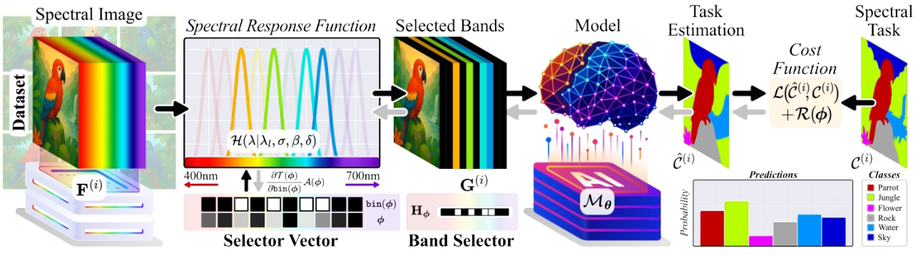
Deep learning-based spectral band selection for hyperspectral imaging tasks
An end-to-end framework that jointly learns task-specific hyperspectral band selection and a neural model for classification and segmentation.
A Multimodal hyperspectral dataset of cocoa beans with physicochemical annotation
A multimodal hyperspectral dataset of cocoa beans with physicochemical annotations for non-invasive quality assessment.
Learning-based Spectral Regression for Cocoa Bean Physicochemical Property Prediction
Predict physicochemical properties of cocoa beans from VIS-NIR spectral data using learning-based regression; dataset collected from Santander and evaluated across regions.
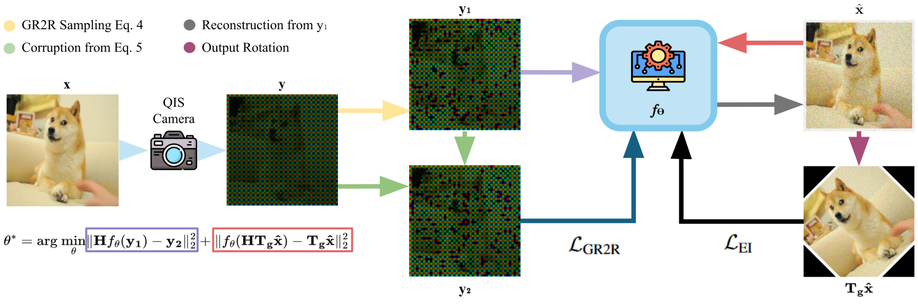
Self-Supervised Low-Light Quantum RGB Image Demosaicing
Image acquisition in low-light environments is fundamentally challenging due to the photon-limited nature of the scene, which results in severe noise and incomplete color information. Imaging sensors operating under such conditions require robust post-processing to recover visually coherent, full-color images. In these conditions, the photon arrival process can be modeled as a Poisson distribution, which introduces noise that complicates image reconstruction. Furthermore, the use of a color filter array leads to missing color information at each pixel, which exacerbates the challenge. As a result, denoising and demosaicing become ill-posed and interdependent tasks. We propose a self-supervised method that jointly addresses denoising and demosaicing under low-light conditions without requiring clean reference images. Our approach achieves a PSNR higher by 2.0 dB compared to best state-of-the-art methods at gain of 20 and is close to the supervised method.
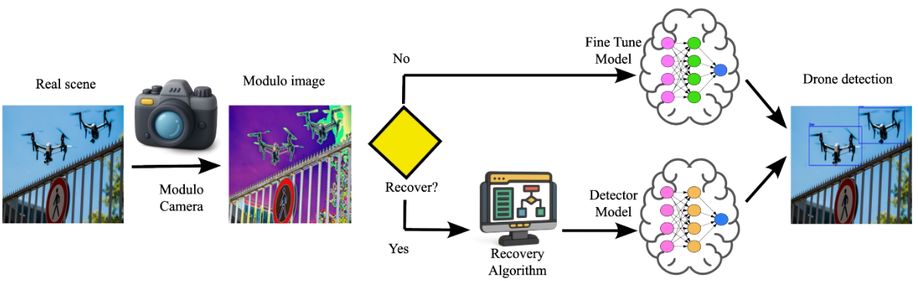
Deep Robust Object Detection Under High Illumination Conditions Using Modulo Images
Drone detection under high-illumination conditions remains a critical challenge due to sensor saturation, which degrades visual information and limits the performance of conventional detection models. A promising alternative to overcome this issue is modulo imaging, an approach based on modulo-ADCs that reset pixel intensities upon reaching a predefined saturation threshold, thus avoiding saturation loss. This work presents a methodology based on fine-tuning a detection model using modulo images, allowing accurate object detection without requiring High Dynamic Range (HDR) image reconstruction. Additionally, an optional reconstruction stage using the Autoregressive High-order Finite Difference (AHFD) algorithm is evaluated to recover high-fidelity HDR content. Experimental results show that the fine-tuned model achieves F1-scores above 96% across different illumination levels, outperforming saturated and raw modulo inputs, and approaching the performance of ideal HDR images. These findings demonstrate that fine-tuning with modulo data enables robust drone detection while reducing inference time, making the reconstruction process optional rather than essential.
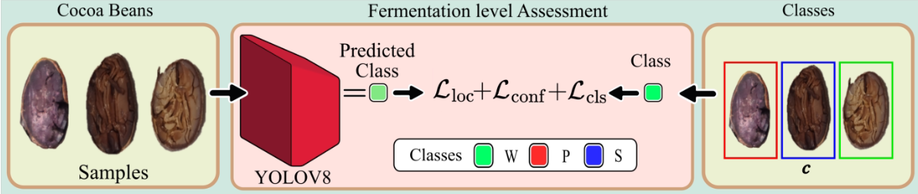
Automated Classification of Cocoa Bean Fermentation Levels Using Computer Vision
This study presents an automated system for classifying the fermentation levels of cocoa beans using convolutional neural networks, specifically employing YOLO-based object detection models. RGB images of cocoa beans, which were cut using a guillotine to expose their internal structure, were analyzed and manually labeled by experts according to the NTC 1252:2021 standard. A dataset of 19 high-resolution images, containing approximately 1,850 annotated beans, was used for both training and evaluation. Four versions of YOLOv8 (n, s, m, l) were tested, with YOLOv8m demonstrating the best overall performance, achieving an Intersection over Union (IoU) of 0.6522, accuracy of 0.6817, recall of 0.6558, and an F1-score of 0.6685. Comparative tests with earlier YOLO versions (YOLOv5 to YOLOv7) confirmed YOLOv8m as the most efficient model for this task. In addition, it achieved a competitive inference time of 89.87 ms per image. These results highlight the potential of deep learning and computer vision techniques to automate the classification of cocoa bean fermentation levels, providing a faster, more objective alternative to traditional manual inspection methods.
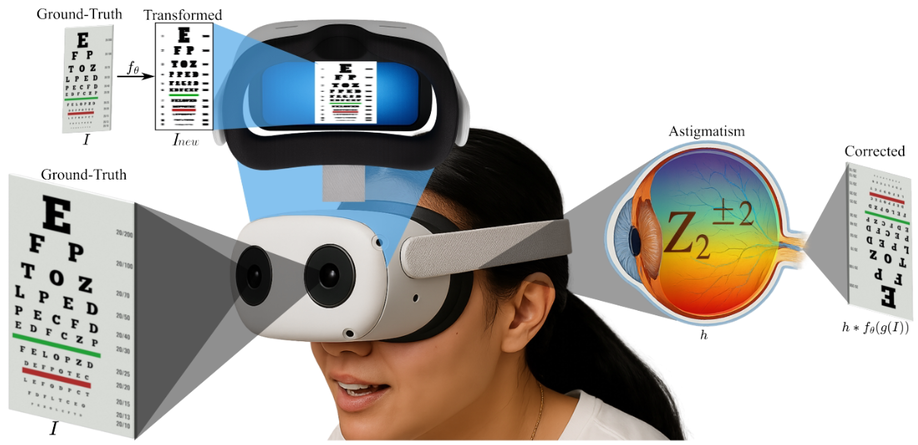
Computational Correction of Eye Aberrations: A Physical Modeling Approach with Zernike Polynomials and Deep Learning
A computational correction strategy for eye aberrations, specifically targeting astigmatism, is proposed. This method computationally designs a transformed image that allows individuals with astigmatism to perceive the original scene with improved clarity. To achieve this, a convolutional neural network (CNN) is trained to minimize the error between a well-defined reference image and an image generated by convolving the transformed image with a simulated point spread function (PSF) representative of a person with astigmatism, modeled using the second-order Zernike polynomials Z22 and Z−22 • Additionally, upsampling techniques are applied to simulate zoom effects in the scene. Quantitative results demonstrate that bicubic scaling with a factor of 2 significantly enhances the perceived visual acuity of the person, increasing SSIM from 0.86 to 0.98 and PSNR from 25.8 dB to 37.7 dB under moderate distortion (severity 1.0). The model was trained on images from the KITTI dataset with simulated aberrations and evaluated on the DIV2K dataset, confirming its generalization to out-of-distribution data. These results highlight the effectiveness of integrating physics-based optical modeling with deep learning for ocular aberration correction.

Autoregressive High-Order Finite Difference Modulo Imaging: High-Dynamic Range for Computer Vision Applications
High dynamic range (HDR) imaging is vital for capturing the full range of light tones in scenes, essential for computer vision tasks such as autonomous driving. Standard commercial imaging systems face limitations in capacity for well depth, and quantization precision, hindering their HDR capabilities. Modulo imaging, based on unlimited sampling (US) theory, addresses these limitations by using a modulo analog-to-digital approach that resets signals upon saturation, enabling estimation of pixel resets through neighboring pixel intensities. Despite the effectiveness of (US) algorithms in one-dimensional signals, their optimization problem for two-dimensional signals remains unclear. This work formulates the US framework as an autoregressive l2 phase unwrapping problem, providing computationally efficient solutions in the discrete cosine domain jointly with a stride removal algorithm also based on spatial differences. By leveraging higher-order finite differences for two-dimensional images, our approach enhances HDR image reconstruction from modulo images, demonstrating its efficacy in improving object detection in autonomous driving scenes without retraining.
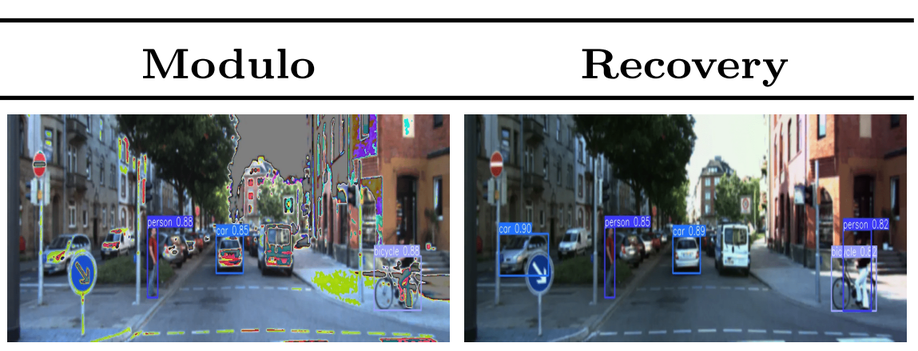
High Dynamic Range Modulo Imaging for Robust Object Detection in Autonomous Driving
Object detection precision is crucial for ensuring the safety and efficacy of autonomous driving systems. The quality of acquired images directly influences the ability of autonomous driving systems to correctly recognize and respond to other vehicles, pedestrians, and obstacles in real-time. However, real environments present extreme variations in lighting, causing saturation problems and resulting in the loss of crucial details for detection. Traditionally, High Dynamic Range (HDR) images have been preferred for their ability to capture a broad spectrum of light intensities, but the need for multiple captures to construct HDR images is inefficient for real-time applications in autonomous vehicles. To address these issues, this work introduces the use of modulo sensors for robust object detection. The modulo sensor allows pixels to ‘reset/wrap’ upon reaching saturation level by acquiring an irradiance encoding image which can then be recovered using unwrapping algorithms. The applied reconstruction techniques enable HDR recovery of color intensity and image details, ensuring better visual quality even under extreme lighting conditions at the cost of extra time. Experiments with the YOLOv10 model demonstrate that images processed using modulo images achieve performance comparable to HDR images and significantly surpass saturated images in terms of object detection accuracy. Moreover, the proposed modulo imaging step combined with HDR image reconstruction is shorter than the time required for conventional HDR image acquisition.
JR2net: A Joint Non-Linear Representation and Recovery Network for Compressive Spectral Imaging
A joint non-linear representation and recovery network for compressive spectral imaging.
Shift-Variant Color-Coded Diffractive Spectral Imaging System
Shift-variant color-coded diffractive spectral imaging system jointly designing DOE and CCA parameters for high-fidelity spectral reconstruction.
Two-step Deep Learning Framework for Chronic Wounds Detection and Segmentation: A Case Study in Colombia
Two-step deep learning framework for detection and segmentation of chronic wounds presented at STSIVA 2021.
Deep Low-Dimensional Spectral Image Representation for Compressive Spectral Reconstruction
Deep low-dimensional representation for compressive spectral reconstruction presented at IEEE MLSP 2021.